Bitcoin Dominance (BTC.D) — Live Chart, History and Altcoin Rotation
What is BTC Dominance right now?
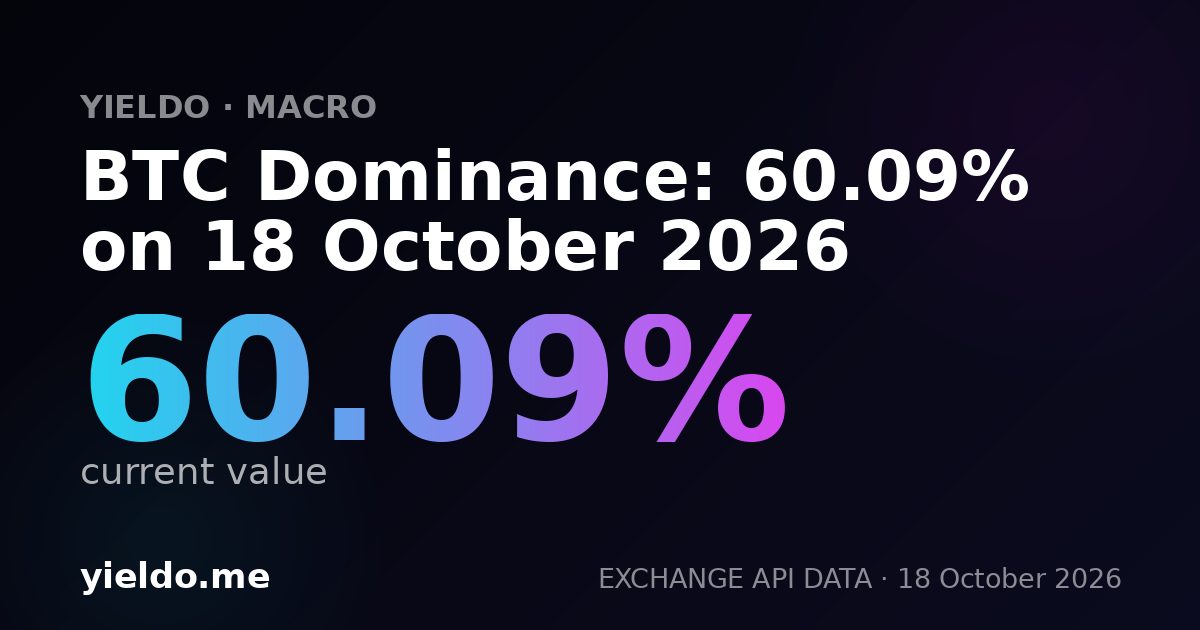
As of 18.10.2026, BTC Dominance is 59.53% (+0.05 pp over a day).
Updated:
BTC Dominance: key numbers
| Metric | Value | Where | As of | Source |
|---|---|---|---|---|
| Current value | 59.53% | BTC Dominance | coingecko | |
| Change over a day | +0.05 pp | BTC Dominance | coingecko | |
| 30-day low | 58.21% | BTC Dominance | coingecko | |
| 30-day high | 59.59% | BTC Dominance | coingecko |
What is BTC Dominance?
Bitcoin Dominance (BTC.D) represents Bitcoin's share of the total cryptocurrency market capitalization. When BTC.D rises, it typically signals a "flight to quality" within crypto, with capital flowing from altcoins to Bitcoin. Falling dominance often signals an "altseason" where altcoins outperform Bitcoin.
How BTC Dominance Affects Crypto Markets
BTC Dominance is a crucial indicator for portfolio allocation decisions. Rising BTC.D (above 55-60%) suggests defensiveness — traders should overweight Bitcoin vs altcoins. Falling BTC.D (below 40-45%) signals altseason — smaller coins may offer outsized returns. The indicator works best when combined with overall market direction: falling BTC.D in a bull market is very bullish for altcoins, while falling BTC.D in a bear market may just mean altcoins are falling even faster.
Value History
2026-02-02 — 2026-10-18 · data points: 259
Data table (rows: 90)
| Date | Value |
|---|---|
| 2026-10-18 | 59.53% |
| 2026-10-17 | 59.48% |
| 2026-10-16 | 59.39% |
| 2026-10-15 | 59.30% |
| 2026-10-14 | 59.27% |
| 2026-10-13 | 59.28% |
| 2026-10-12 | 59.26% |
| 2026-10-11 | 59.59% |
| 2026-10-10 | 59.10% |
| 2026-10-09 | 59.17% |
| 2026-10-08 | 59.08% |
| 2026-10-07 | 58.77% |
| 2026-10-06 | 58.73% |
| 2026-10-05 | 58.68% |
| 2026-10-04 | 59.28% |
| 2026-10-03 | 58.61% |
| 2026-10-02 | 58.78% |
| 2026-10-01 | 58.67% |
| 2026-09-30 | 58.30% |
| 2026-09-29 | 58.35% |
| 2026-09-28 | 58.31% |
| 2026-09-27 | 58.78% |
| 2026-09-26 | 58.27% |
| 2026-09-25 | 58.21% |
| 2026-09-24 | 58.57% |
| 2026-09-23 | 58.85% |
| 2026-09-22 | 58.72% |
| 2026-09-21 | 58.82% |
| 2026-09-20 | 58.69% |
| 2026-09-19 | 58.86% |
| 2026-09-18 | 58.41% |
| 2026-09-17 | 58.13% |
| 2026-09-16 | 58.41% |
| 2026-09-15 | 58.49% |
| 2026-09-14 | 58.48% |
| 2026-09-13 | 58.88% |
| 2026-09-12 | 58.24% |
| 2026-09-11 | 58.28% |
| 2026-09-10 | 58.46% |
| 2026-09-09 | 58.58% |
| 2026-09-08 | 58.34% |
| 2026-09-07 | 59.11% |
| 2026-09-06 | 59.19% |
| 2026-09-05 | 58.81% |
| 2026-09-04 | 59.24% |
| 2026-09-03 | 59.39% |
| 2026-09-02 | 59.06% |
| 2026-09-01 | 59.12% |
| 2026-08-31 | 59.16% |
| 2026-08-30 | 59.58% |
| 2026-08-29 | 59.02% |
| 2026-08-28 | 58.98% |
| 2026-08-27 | 59.21% |
| 2026-08-26 | 59.09% |
| 2026-08-25 | 59.23% |
| 2026-08-24 | 59.04% |
| 2026-08-23 | 59.15% |
| 2026-08-22 | 58.83% |
| 2026-08-21 | 58.98% |
| 2026-08-20 | 58.68% |
| 2026-08-19 | 56.58% |
| 2026-08-18 | 56.64% |
| 2026-08-17 | 56.52% |
| 2026-08-16 | 56.14% |
| 2026-08-15 | 56.16% |
| 2026-08-14 | 56.12% |
| 2026-08-13 | 56.25% |
| 2026-08-12 | 56.27% |
| 2026-08-11 | 56.27% |
| 2026-08-10 | 56.49% |
| 2026-08-09 | 56.64% |
| 2026-08-08 | 56.67% |
| 2026-08-07 | 56.78% |
| 2026-08-06 | 56.62% |
| 2026-08-05 | 56.62% |
| 2026-08-04 | 56.56% |
| 2026-08-03 | 56.39% |
| 2026-08-02 | 56.26% |
| 2026-08-01 | 56.32% |
| 2026-07-31 | 56.23% |
| 2026-07-30 | 56.58% |
| 2026-07-29 | 56.49% |
| 2026-07-28 | 56.40% |
| 2026-07-27 | 56.45% |
| 2026-07-26 | 56.52% |
| 2026-07-25 | 56.51% |
| 2026-07-24 | 56.56% |
| 2026-07-23 | 56.74% |
| 2026-07-22 | 56.72% |
| 2026-07-21 | 56.81% |
Latest AI Analysis
RETURN OF RISK APPETITE
🟢 Positive — Sentiment has improved, but fund demand still lags
Risk appetite is back: the Fear & Greed Index rose from 53 to 63, entering greed territory. Yet bitcoin funds have recorded outflows for a second consecutive day — sentiment is running ahead of demand. Reports of possible escalation around Iran and strikes between Russia and Ukraine keep the risk of higher energy prices and a flight to safety in play. Meanwhile, prediction markets put the probability of a US recession at just 7.5%. The sentiment turnaround is encouraging, but its staying power remains uncertain without renewed fund inflows.
WHAT TO WATCH
A Fear & Greed Index close above 63 on October 17 would confirm further improvement in sentiment. This test would not establish that fund demand has returned.
Related Indicators
Impact on Crypto Trading
What is BTC Dominance?
Bitcoin dominance (BTC.D) measures Bitcoin's market capitalization as a percentage of the total cryptocurrency market cap. A BTC.D of 60% means Bitcoin holds 60% of all crypto market value, while altcoins collectively represent the remaining 40%.
BTC Dominance and Altseason
Altseason typically begins when Bitcoin dominance starts declining after a period of BTC-led growth. When money flows from Bitcoin into altcoins, BTC.D drops. Historical altseasons in 2017-2018 and 2021 saw BTC.D fall from 60-70% to 35-40%. Traders watch BTC.D as a key rotation signal.
Historical Trends
In 2017, BTC.D dropped from 95% to 35% during the ICO boom. In 2021, it fell from 70% to 40% during the DeFi/NFT mania. Each cycle sees lower BTC.D peaks as the altcoin ecosystem matures. The current cycle started with BTC.D around 50-55%.
How to Use BTC Dominance in Trading
Rising BTC.D: Focus on Bitcoin positions. Falling BTC.D: Consider rotating into quality altcoins. Combine with Fear & Greed Index (extreme greed + falling BTC.D = peak altseason) and DXY (weak dollar supports risk assets including alts).
Related Macro Indicators
FAQ
What is Bitcoin dominance (BTC.D)?
What is the current Bitcoin dominance?
What does falling BTC dominance mean?
How low does BTC dominance go in an altseason?
How to use BTC dominance for trading?
Is Bitcoin dominance a reliable indicator?
Weekly Macro Review in Telegram
One independent weekly review, every Monday at 09:00 MSK. You can turn it off below any issue.
Open Telegram Bot