When you sell a position on Polymarket, you receive proceeds for the shares that buyers actually take. Add the amount you receive at each execution price and subtract any trading fees. You can sell the remaining shares later or hold them until the market resolves.
 Eugen Voyager

Contents
How many shares can you sell?
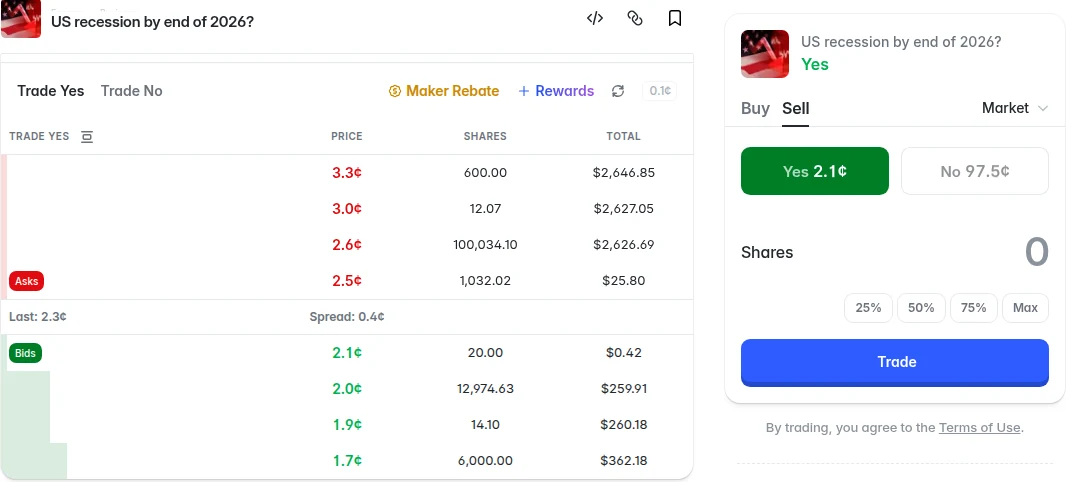
On the Polymarket International market page, switch to Sell and choose the outcome you hold, Yes or No. Expand the A list of buy and sell orders with their prices and sizes. A trade occurs when compatible orders from two sides are matched. and select the same outcome. The rows under Bids show what buyers offer in Price and how many shares they will buy in Shares. An immediate sale starts at the highest bid. If buyers at that price only take part of your order, the next part fills at a lower bid. See Polymarket's guide to selling early.
The outcome price on the market page is usually halfway between the best bid and the lowest asking price. If the gap is wider than 10 cents, Polymarket displays the last trade price. To estimate proceeds for your full order, add up the bids you would fill. If bids change after your estimate and you get a worse price, the difference is slippage. See how Polymarket displays prices.
How much pUSD do you receive after fees?
Say you want to sell 10 Yes shares. You're willing to accept 0.58 or more. Two bids meet that minimum, one for 4 shares at 0.63 and one for 3 at 0.58. Seven shares fill for gross proceeds of 4.26 pUSD.
When you fill an existing bid immediately, you trade as a taker. On markets that charge trading fees, the fee depends on the number of shares filled, their price and the market's fee coefficient. If your order rests in the book and someone else fills it, you're the maker. That fill is fee-free for you.
Use a coefficient of 0.07 for this example. Look up your market’s rate in its market settings. The Polymarket formula multiplies the share count by the coefficient, the price and one minus the price. Calculate the fee for each fill and round it to five decimal places. Polymarket lists fees in USDC. Below, we express proceeds and the resulting balance in pUSD, its USDC-backed trading token.
- 4 × 0.63 = 2.52 pUSD. The fee calculation is 4 × 0.07 × 0.63 × 0.37 → 0.06527 after rounding.
- 3 × 0.58 = 1.74 pUSD. The fee calculation is 3 × 0.07 × 0.58 × 0.42 → 0.05116 after rounding.
In this example, the sale adds 4.14357 pUSD to your trading balance after 0.11643 in fees comes out of the 4.26 in proceeds. To calculate your profit or loss, subtract what you paid for those 7 shares, including any fee you paid when buying them.
What happens to the remaining shares?
Under Sell, Market uses available bids. Choose Limit to set the minimum price you will accept. If an existing bid meets or exceeds that price, the order can fill immediately. Before selling again, check how many shares sold and whether an open order is still waiting to sell the rest. Polymarket shows open orders under the order book and under Open orders on the Portfolio page. Click the × beside an open order to cancel the unfilled part. See Polymarket's instructions for managing limit orders.
For orders placed through the API, Polymarket documents three ways to handle the example. A GTC limit order leaves an order for 3 shares open until it fills or you cancel it. FAK fills the available 7 shares and cancels the rest. FOK requires an immediate fill for all 10 at your price limit or better, so these bids would produce no trades.
When can you get pUSD back without selling?
Once a market has resolved, redeem your shares for the recorded payout. A standard binary outcome pays 1 pUSD for a winning share and 0 for a losing share. If you hold both Yes and No in the same binary market, you can merge them in pairs. For example, 7 Yes and 4 No let you merge 4 pairs for 4 pUSD and keep 3 Yes. See Polymarket's documentation on redemption and merging.
Selling, redeeming and merging return funds to your trading balance. Our Polymarket guide explains deposits, withdrawals and how the platform resolves an event.
For a different fee mechanism, see the Kalshi calculation for buying, selling and settlement.
EV
Eugen Voyager
Crypto analyst and blockchain developer. In the industry since 2018. Creator of Telochain blockchain, GameFi project Telomeme, and Yieldo platform. Author of Telegram channel @tonsdot.
How we collect and check data — Yieldo's methodology.
How we publish, date and correct material — editorial policy.