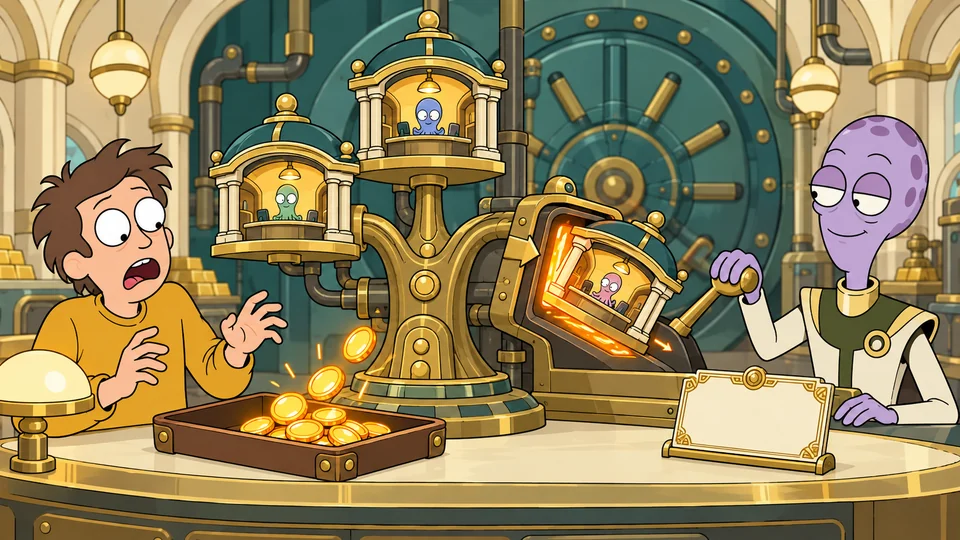
Standard Reserve is a Robinhood Chain protocol where an A token with its own identifier representing a collectible, an in-game item or another digital asset. The blockchain records which address owns the token. opens a “bank,” its Branches receive a share of STANDARD issuance, and withdrawing the accrued balance retires some of those Branches. The team is extending that economy with a launchpad: new tokens will trade against tokenized stocks using reserve-owned liquidity.
The banking vocabulary describes a concrete choice: expand your share of future issuance or collect what your bank has earned. Here is how the NFT, licenses and token connect, followed by the role of King of the Markets. Rules and announcements were checked on October 12, 2026.
The NFT, the Branch and STANDARD
A Charter is the NFT that lets its owner operate a bank inside the protocol. A new Charter includes one Branch. Each Charter can hold up to ten Branches.
Branches share protocol issuance. Three Branches out of three thousand give your bank one thousandth of the distribution. Adding a Branch increases your bank’s share; other participants opening Branches changes the denominator.
STANDARD is a separate ERC-20 token. People trade it against ETH and spend it to expand their banks. Buying the token on the market and running an NFT bank are separate ways to participate in the protocol’s economy.
The network is Robinhood Chain, chain ID 4663. STANDARD’s contract is 0x88ad8DdF1E3898412146a534538d418c6F8A9062. The official site links to STANDARD on Uniswap.
Where the accrual comes from
The protocol issues STANDARD under its monetary policy. It measures ETH entering the main pool through purchases and leaving through sales. Sustained inflows allow issuance to rise; outflows reduce it. Issuance policy uses two completed accounting periods, while fee routing follows the current period’s flow.
One Branch’s daily share of new issuance is base issuance × policy multiplier ÷ total open Branches. Base issuance started at 700,000 STANDARD per day, and the owner can lower that amount. The policy multiplier ranges from 0.2 to 1.25. Redistributed fees add to the accrual of the remaining bankers.
For scale, the official interface on the evening of October 12 showed 971 active banks, 3,394 Branches and a 0.35 multiplier. With the 700,000 base, that works out to about 72.2 STANDARD per Branch per day. The number describes that particular system state; policy and the number of open Branches change it.
Accrual first appears on the bank’s internal balance. Wallet tokens are minted when a banker withdraws. The original issuance ceiling is one billion STANDARD, and permanent burns reduce that ceiling.
To compare this model with other projects, explore four Revenue mechanisms: creator fees, protocol revenue, token buybacks and holder distributions. Each traces where the money comes from and who receives it.
Buying licenses and retiring Branches
New Charters sell at an ETH auction. Expanding an existing bank requires an expansion license, paid for in STANDARD. The entire license payment is burned, and another Branch opens. Both auctions use falling prices: they start high and decline until buyers take the available supply.
Withdrawal retires a chosen number of Branches and releases the same fraction of the bank’s accrued balance. Retiring one of ten Branches releases one tenth of the balance. The remaining nine keep working.
Retiring the final Branch burns the Charter itself. Opening a bank again after a complete exit requires a new auctioned NFT. A license therefore buys future earning capacity: expansion spends STANDARD, while withdrawal spends that capacity.
The released balance pays a resolution fee. Its rate depends on system-wide withdrawal pressure over the preceding seven days and ranges from 2% to 60%. Half of the fee is burned and half goes to the bankers who remain.
Illustrative example: a bank with ten Branches has accrued 10,000 STANDARD. Retiring one Branch releases 1,000. At a 2% fee, the wallet receives 980, ten are burned, and ten go to the remaining bankers. The bank then has nine working Branches.
Banks also have an activity rule. After 30 days without activity, a bank can be revoked: its Branches close, its Charter burns, and a 70% fee applies. A free check-in on the site refreshes the activity clock.
Where ETH and trading fees go
Main-pool traders pay for swaps, and buyers of new Charters pay to enter the system. That ETH feeds a shared distribution mechanism. The current whitepaper section describes three destinations:
- 70% to the active vault. During inflows, the expansion vault accumulates reserves and purchases reserve assets, including tokenized gold. During outflows, the contraction vault buys STANDARD on the market and burns what it acquires.
- 15% to STANDARD buybacks held in the Incentives Vault. These tokens are retained for future participant incentive programs.
- 15% to the team.
Trading and Charter auctions bring in ETH. Bank expansion creates demand for STANDARD and burns license payments. Branch accrual comes from token issuance. For the different uses of protocol fees, see buybacks, burns and distributions.
King of the Markets and stock liquidity
On October 6, the team introduced Standard Launchpad, where each new token pairs with a Stock Token. The Reserve plans to provide deep underlying stock pools using liquidity it owns.
The idea is to send new launches and their traders toward a shared liquidity base. Trading generates fees, which the team plans to use for deeper pools, treasury growth and STANDARD buybacks. Our Robinhood Stock Tokens guide explains the stock instruments themselves; on this launchpad, the stock token is the other asset in a new token’s trading pair.
The first pilot is King of the Markets. The October 12 announcement schedules a start on October 14, 2026, lasting 14 days. The starting jackpot is one million USDG, and 20% of trading fees during the pilot contribute to the rewards pot.
Countries compete through trading pairs. Each participating country is assigned a Stock Token. A deployer chooses that stock when launching a token, linking the launch to a country. Trading volume adds to that country’s score. Deployers earn points from the volume their tokens attract; traders earn points by trading. Participants with points share part of the rewards, and those who contributed to the winning country also split the jackpot.
This gives the Reserve’s own launchpad a clear purpose: bring trading demand to markets funded by the protocol’s reserves. The details are in the official King of the Markets announcement.
People discussing Standard Reserve
The project brings together NFT and crypto-trading voices. These own posts offer useful starting points:
- 0xSammy examines the first auctions, issuance and bank expansion economics.
- ika discusses buying another Charter and routes into the ecosystem.
- MINHxDYNASTY reminds bank owners to check in.
- Xeer offers a critical perspective and describes changing his view of the project.
- JBond introduces the project ahead of its Genesis mint.
- wale explains a plan to spend STANDARD on another Branch.
- camol shares an exuberant reaction to Charter accrual.
- Pedro discusses incentives for trading meme tokens against stocks.
Find these authors in XFollowList’s Robinhood Chain collection. To explore the network, continue with the wallet-to-first-trade guide and Robinhood meme markets on Yieldo.
The economic connection
Standard Reserve links three participant decisions. Buying a Charter contributes ETH and opens a bank. Adding a Branch spends and burns STANDARD for a larger share of future issuance. Collecting the balance retires Branches and pays a fee split between burning and the remaining bankers.
The launchpad adds another source of activity. New tokens use Stock Token liquidity, traders pay fees, and the protocol receives funds to develop its markets and economy. The mechanism to understand is how NFT banks and a trading venue connect STANDARD issuance with participant spending and reserve inflows.
Read the full rules in the Standard Reserve whitepaper. Bank management and auctions are on the official site.